
Sarasota County Court Records After Arrest
The arrest-to-court path in Sarasota County runs through several offices. A person is booked at the Sarasota County Jail, appears before a judge for first appearance and bond review, and then the Office of the State Attorney for the Twelfth Judicial Circuit decides what formal charges to file. Once those charges are filed, the court record lives with the Sarasota Clerk of the Circuit Court and County Comptroller, not on the jail roster.
The sheriff's roster can be useful for the arrest side, including booking date, booking photo, bond, and the original arrest charges. The court record is different. It tracks the case, the formal filed charges, court dates, motions, dispositions, and whether a charge was amended, dismissed, reduced, or resolved. For custody and booking details, use Sarasota County inmate records. For booking photos, use Sarasota County jail mugshots.
Search Sarasota County Court Records After Arrest
The main online case portal is ClerkNet 3.0. The Twelfth Judicial Circuit also provides online case search guidance for Sarasota, Manatee, and DeSoto counties. Public access can search by defendant name or case number. Registered-user access is available for parties, attorneys, agencies, and other approved users with elevated permissions.
- Open ClerkNet 3.0 or the Twelfth Circuit case-search guidance page.
- Choose general public access unless you qualify for registered access.
- Search by defendant name or case number.
- Open the criminal case and compare filed charges with the booking charges.
- Review status, court dates, documents, and disposition where public access permits.
Some images are restricted. Sealed or expunged cases are not available in normal public results, and certified documents can take up to 24 business hours.
The official ClerkNet source is shown in the captured image below.
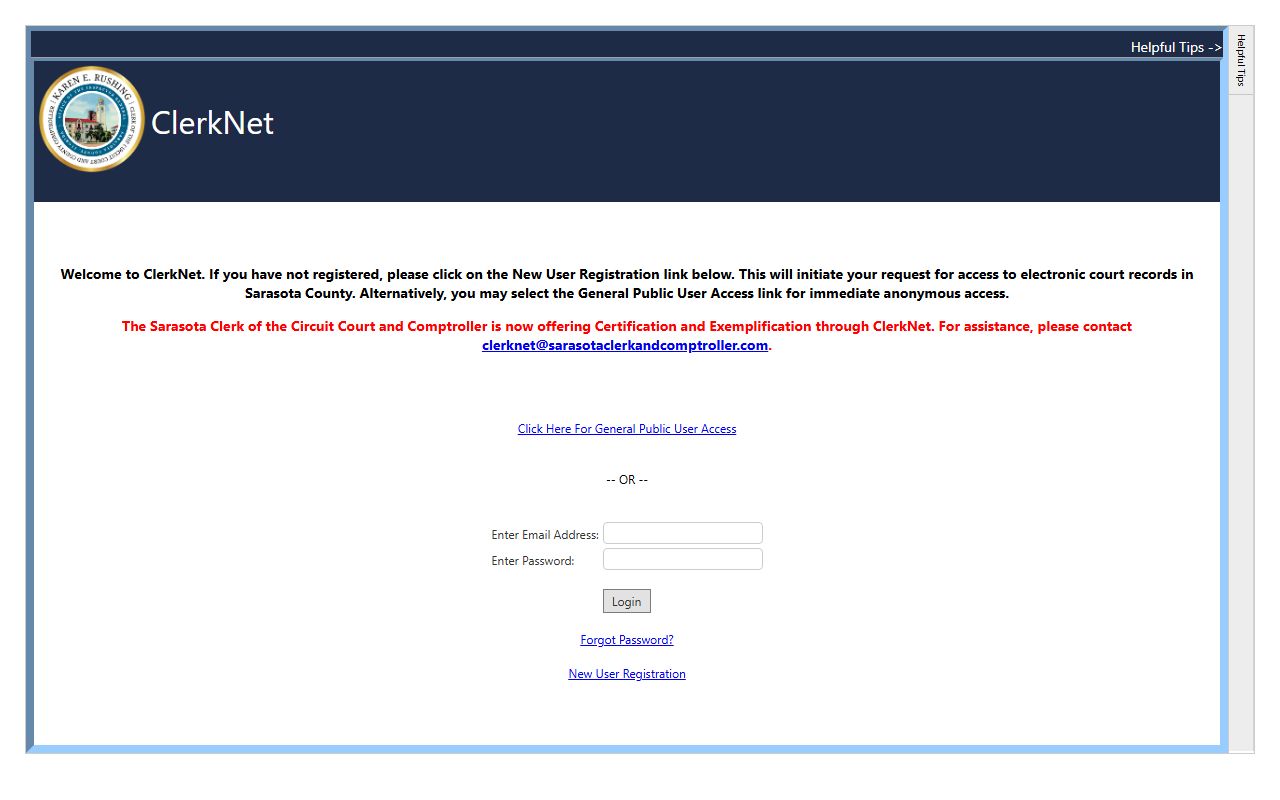
The portal is for court case records, not for confirming a person's current jail housing.
Sarasota County Arrest Charging Documents
Formal charge filing is the key step between a jail arrest and the court record. In Florida, the prosecutor often files an information for criminal charges. A complaint or charging affidavit can appear at the arrest stage, while a grand jury indictment is used for the most serious cases, including capital matters.
| Document | Filed by | What it does |
|---|---|---|
| Complaint / charging affidavit | Law enforcement or prosecutor | States the arrest-stage facts and alleged offense |
| Information | State Attorney | Formally files many Florida felony and misdemeanor charges |
| Indictment | Grand jury | Files charges in serious cases where grand jury action is required |
The Office of the State Attorney, Twelfth Judicial Circuit, led by State Attorney Ed Brodsky, handles charging decisions for Sarasota, Manatee, and DeSoto counties. Its Sarasota office is at 2071 Ringling Blvd, Sarasota, FL 34237, and the main phone is 941-861-4400.
Sarasota County Charge Status
Charge status can change after the arrest. A booking charge may be amended or reduced once the State Attorney reviews reports, witness statements, and evidence. A charge can also be dismissed by the court, dropped by the prosecutor, or resolved by plea or trial. That is why court records after a jail arrest carry more legal weight than the first roster entry.
| Status | Meaning |
|---|---|
| Pending | The charge is active and not yet resolved. |
| Amended | The charge language, degree, or count has been changed. |
| Reduced | The charge moved to a less serious offense or level. |
| Dismissed | The court dismissed the charge or it is no longer proceeding. |
| Nolle prosequi | The prosecutor decided not to pursue the charge. |
| Adjudication withheld | The court withholds a formal conviction despite a finding or plea. |
Bond After Sarasota County Arrest
Bond is usually addressed at first appearance, held at the jail Monday through Friday at 1:00 p.m. and on weekends or holidays at 9:00 a.m. A judge considers the charge, criminal history, public safety, flight risk, and pre-trial services information. Bond can be cash, surety, personal recognizance, or unavailable because of a no-bond order or outside hold.
| Bond type | How it works |
|---|---|
| Cash bond | The full amount is posted in cash or approved payment form. |
| Surety bond | A licensed bondsman posts bond for a non-refundable premium. |
| PR / own recognizance | The person is released on a written promise to appear. |
| No-bond hold | Release is blocked by court order, warrant, detainer, or other hold. |
GovPayNet accepts Sarasota County Jail bail payments up to $7,500 by card. Payment does not guarantee immediate release if another county, ICE, FDC, or federal hold remains active.
Warrants Before Sarasota County Arrest
A warrant can lead directly to booking at the Sarasota County Jail. The research did not find a full public warrant table on the corrections pages, so warrant status is normally confirmed through the SCSO Records Section, the 24-hour inmate information line, or the court clerk for bench warrants and failure-to-appear issues. A bench warrant is a judge's order, often tied to a missed court date.
Once the person is arrested on a warrant, the booking can appear on the sheriff roster. The court record after that arrest may show the old case, the new charge, or both, depending on why the warrant was issued.
Sarasota County Charges vs Convictions
A charge is an accusation. A conviction is a court finding of guilt or a plea accepted by the court. Court records after a jail arrest may contain both pending charges and resolved dispositions, so the status line matters more than the mere presence of a charge.
| Charge | Conviction | |
|---|---|---|
| Stage | Accusation filed by the state | Final finding or plea |
| Proof level | Probable cause or charging standard | Beyond a reasonable doubt or accepted plea |
| Effect | Can be amended, dropped, or dismissed | Can affect sentence, rights, and record history |
| Lookup source | ClerkNet case docket | ClerkNet disposition and FDLE history where applicable |
Sealed and Expunged Arrest Records
Florida has separate sealing and expunction statutes. Sealing hides an eligible record from normal public access while allowing limited agency access. Expunction is more restrictive and treats an eligible record as removed from ordinary public access after the required process. The FDLE Certificate of Eligibility process includes a $75 fee, and the court makes the final decision.
| Sealed | Expunged | |
|---|---|---|
| Public view | Hidden from general public access | Removed from normal public access |
| Agency access | Limited agencies may still see it | More limited access after expunction |
| Law | Fla. Stat. 943.059 | Fla. Stat. 943.0585 |
| Process | FDLE eligibility plus court order | FDLE eligibility plus court order |
Sealing or expunction can affect court access and official records. It does not make third-party copies disappear automatically, and it is not the same as a jail release.
Restricted Court Records After Arrest
Public access is broad in Florida, but it is not unlimited. Sealed cases, expunged cases, juvenile material, protected victim information, and some images are restricted. For statewide criminal history, FDLE offers a name-based Florida computerized criminal history search for $24. For arrest-side reports and booking documents, the sheriff's public-records process remains the right channel.
ClerkNet access level can also affect what a user sees. General public access is appropriate for most name or case-number searches. Registered-user access can expose additional permitted material for parties, attorneys, agencies, and other approved users under Florida court access rules. A missing image does not always mean the case does not exist; it may mean the image is restricted from remote public viewing or must be requested from the clerk.
The Twelfth Circuit guidance page is shown below.
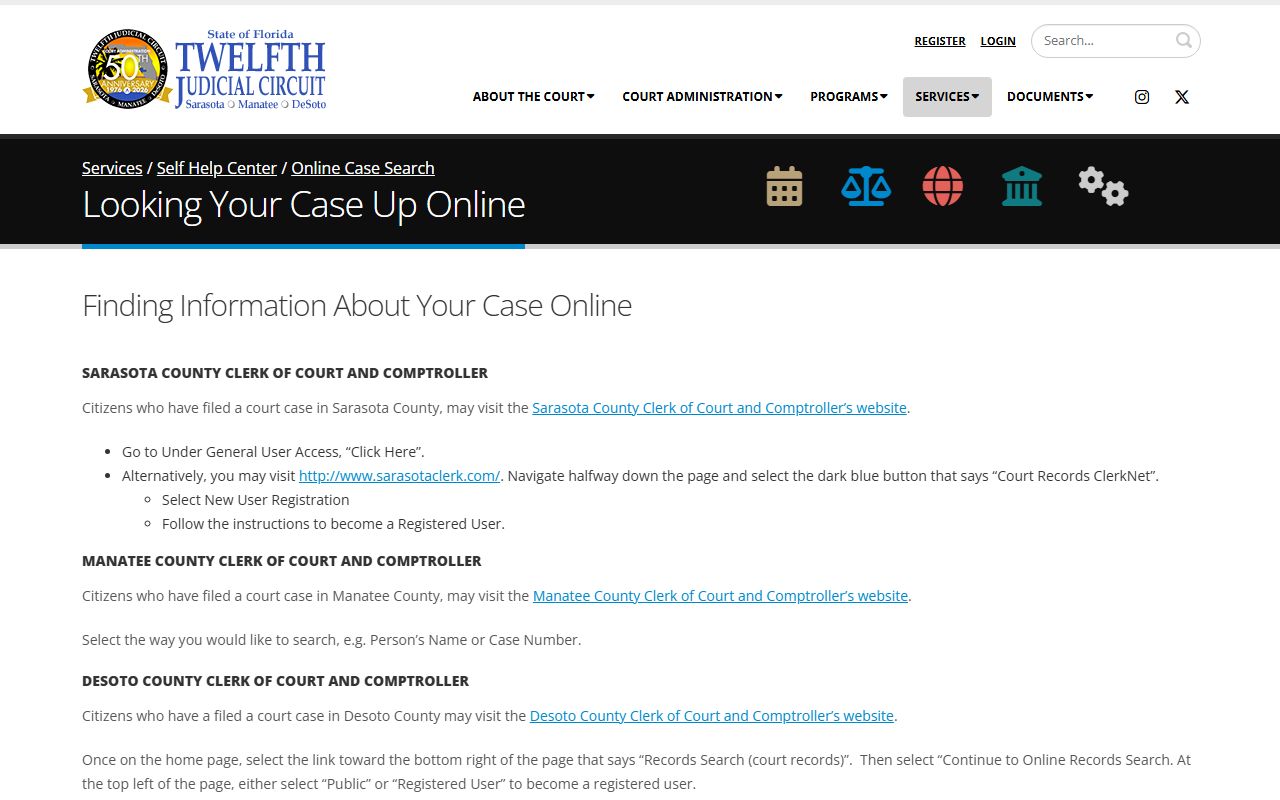
Use the court guidance page when ClerkNet access choices or county-specific portals are unclear.
Important: Court records after an arrest should not be used for FCRA-covered screening through this site or its search tools.